A purposeful workout does not need to take over your living room. Pilates boards offer a compact option for home training, helping you make space for controlled movement and a consistent routine.
Whether you are exploring Pilates for the first time or adding variety to your workouts, start with the basics: understand your equipment, choose appropriate movements, and focus on technique before intensity. Here is your guide to getting started with Pilates board workouts.
What is a Pilates board?
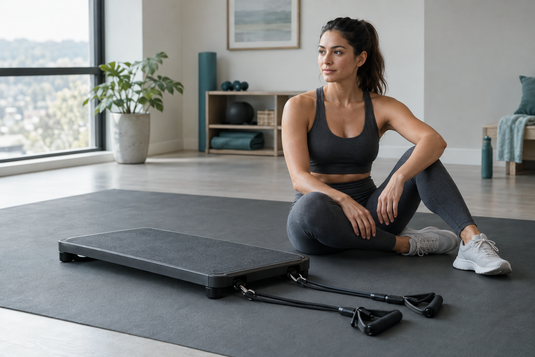
A Pilates board is a platform used for Pilates-inspired exercises. Designs vary: some feature sliding components, resistance attachments, handles, or folding sections. The exercises you can perform depend on the board's construction and the manufacturer's instructions.
A compact Pilates board is not necessarily equivalent to a studio Pilates reformer. Check the equipment's intended use rather than assuming it supports every exercise you have seen in a reformer class.
Why consider a Pilates board for home workouts?
- A dedicated training space: A board can give your home routine a clear starting point without requiring a full studio setup.
- A focus on control: Suitable exercises encourage you to pay attention to your position, breathing, and movement speed.
- Variety in your routine: Depending on the design, a board may offer options for core-focused work and upper- or lower-body exercises.
The best equipment is equipment you can use safely and consistently. Choose a board that fits your space, experience, and preferred training style.
How to start a Pilates board workout
1. Check your setup
Place the board on a level surface with enough clear space around it. Check that folding sections, attachments, and moving parts are secured according to the instructions. Review the stated weight limits and intended uses before your first session.
2. Learn the movement before adding challenge
Begin with the simplest exercises recommended for your board. Practise getting on and off safely, maintaining a stable position, and controlling any sliding components. Do not add resistance or increase the movement range until you can manage the basic version comfortably.
3. Keep your first session manageable
A short session can be a useful starting point. Warm up with easy movement, practise a small selection of supported exercises, and take breaks as needed. Stop before fatigue makes your technique difficult to maintain.
4. Progress one step at a time
As you become familiar with your board, change one variable at a time: the number of repetitions, the duration of a hold, or the resistance if your equipment allows it. More demanding is not automatically better.
Pilates board exercise ideas
Use only movements approved for your particular board. Depending on its design, your routine might include:
- Supported core holds: Practise a stable trunk position with a variation suited to your ability.
- Controlled leg movements: Work through a comfortable range without allowing moving parts to pull you out of position.
- Upper-body resistance work: If suitable attachments are supplied, follow the recommended setup and maintain a controlled return.
If you are new to Pilates, instruction from a qualified teacher can help you choose appropriate variations. A video demonstrating a different board is not a substitute for your equipment's guidance.
Choosing accessories: check the fit first
Accessories should match your equipment and the way you use it. Before adding a mat or cover, check its dimensions, how it sits on the surface, and whether it could interfere with handles, resistance attachments, or sliding mechanisms.
If you also train on a Pilates reformer, explore Enduran Lab's Non-Slip Pilates Reformer Mat Cover – 100 × 60 cm. Check the product details and your equipment's measurements before choosing it. A reformer mat cover should not be assumed to fit every Pilates board, and it should never obstruct moving parts.
TRAIN, PERFORM, RECOVER with intention
TRAIN: Build familiarity with your board and make controlled technique your priority.
PERFORM: Bring the same attention to your wider training routine. Aim for steady practice rather than rushing through repetitions.
RECOVER: Balance challenging sessions with rest and easier movement. A Pilates board workout can still be demanding, so let effort and fatigue guide your schedule.
Common questions about Pilates boards
Are Pilates boards suitable for beginners?
Some boards offer beginner-friendly options, but suitability depends on the design and the person using it. Read the instructions, start with supported movements, and seek guidance if you are unsure.
Can a Pilates board replace a reformer?
Not necessarily. A studio reformer and a compact board can differ in resistance, construction, and supported exercises. Choose equipment based on what you want to practise, rather than treating the two as interchangeable.
Can I use a reformer mat cover on a Pilates board?
Only if the fit and equipment instructions support it. Check dimensions and placement, and ensure the cover does not interfere with safe operation.
What if an exercise causes pain?
Stop if you experience sharp pain, dizziness, or unusual discomfort. If you have an injury, ongoing symptoms, or concerns about exercise suitability, consult a qualified healthcare professional before starting.
Build a routine you can return to
Home Pilates training works best when your setup is practical and your routine is manageable. Start simple, move deliberately, and build confidence through consistency.
Explore Enduran Lab's Pilates Boards collection to find options for your training setup, and review each product's details before you choose.
Train with purpose. Perform with confidence. Recover with intention.